
Picture this. You wake up on the upper deck of a 60-metre motor yacht somewhere off the Amalfi Coast. The espresso you didn’t order is waiting, the tender has been quietly launched for your morning swim, and the chef has already reshuffled today’s menu because she heard you mention a fondness for Sicilian granita at dinner last night. The captain has rerouted the day’s plan to beat a developing breeze. None of this happened by accident.
A superyacht is one of the most complex hospitality operations on earth, yet the people who make it hum are almost entirely invisible. Guests see polished service, perfect timing and seamless transitions between ports. What they do not see is a rotating cast of 15, 20 or 30 specialists working in shifts, around the clock, in a confined environment, in close quarters, often for months on end.
This is the inside story of a superyacht crew — who they are, what they actually do, how they got there, and why the calibre of that team will shape your charter far more than the size of the boat you step aboard.
The scale: how many crew does a superyacht actually need?
There is an industry rule of thumb that has held for decades: roughly one crew member for every 10 metres of yacht length. A 30-metre yacht runs with 3 to 5 crew. A 50-metre yacht needs 9 to 12. A 70-metre yacht typically carries 16 to 20. A 90-metre-plus gigayacht can run 25 to 30+ full-time professionals, with seasonal contractors brought in for peak charter weeks.
The math is not arbitrary. It is dictated by:
- Maritime safety regulations. Watch-keeping rules under STCW and the International Safety Management (ISM) Code require a minimum number of qualified officers on duty at all times, regardless of whether the yacht is moving or at anchor.
- Guest-to-staff service ratios. Top-end luxury charters target a ratio of 1.5 to 2.5 crew per guest. On a 12-guest yacht, that means 18 to 30 staff in service alone.
- Operational reality. Someone has to drive, navigate, anchor, clean, cook, serve, wash, fold, source, repair, manage, account, plan, communicate, scrub a teak deck at 6 a.m. and polish a stainless-steel fitting in 35°C heat. No one person can do this. No two can either.
The crew of a superyacht is not a perk. It is the operating system.
The bridge: the people who keep the yacht (and you) safe
The captain
The captain is, formally, the master of the vessel. In practical terms, they are simultaneously the chief executive officer, the chief safety officer, the head of guest experience, the head of HR, the chief meteorologist and — in the eyes of maritime law — the person who is legally and personally accountable for everything that happens on board.
A typical day for a superyacht captain starts at 6 a.m. with a weather check, a review of the night watch log, a hand-over from the chief engineer, and a planning meeting with the heads of department. By the time the first guest comes up for breakfast, the captain has usually made a dozen micro-decisions: the day’s route, the lunch anchorage, the tender drivers’ assignments, the dive instructor’s call, the marina reservation confirmation, the customs paperwork for the next flag state.
The captain is also the public face of the yacht. They meet owners, charter guests, brokers, agents, harbourmasters, suppliers, customs officers, contractors and occasionally coastguard officers — often within the same morning. On a busy charter day, they may not leave the bridge for eight hours.
What makes a great captain is not seamanship alone, although that is non-negotiable. It is the combination of technical mastery, social intelligence, calm under pressure, and the rare ability to anticipate what the guests want before the guests themselves know they want it. The best captains are invisible in the way the best concierges are invisible: present when needed, gone the rest of the time.
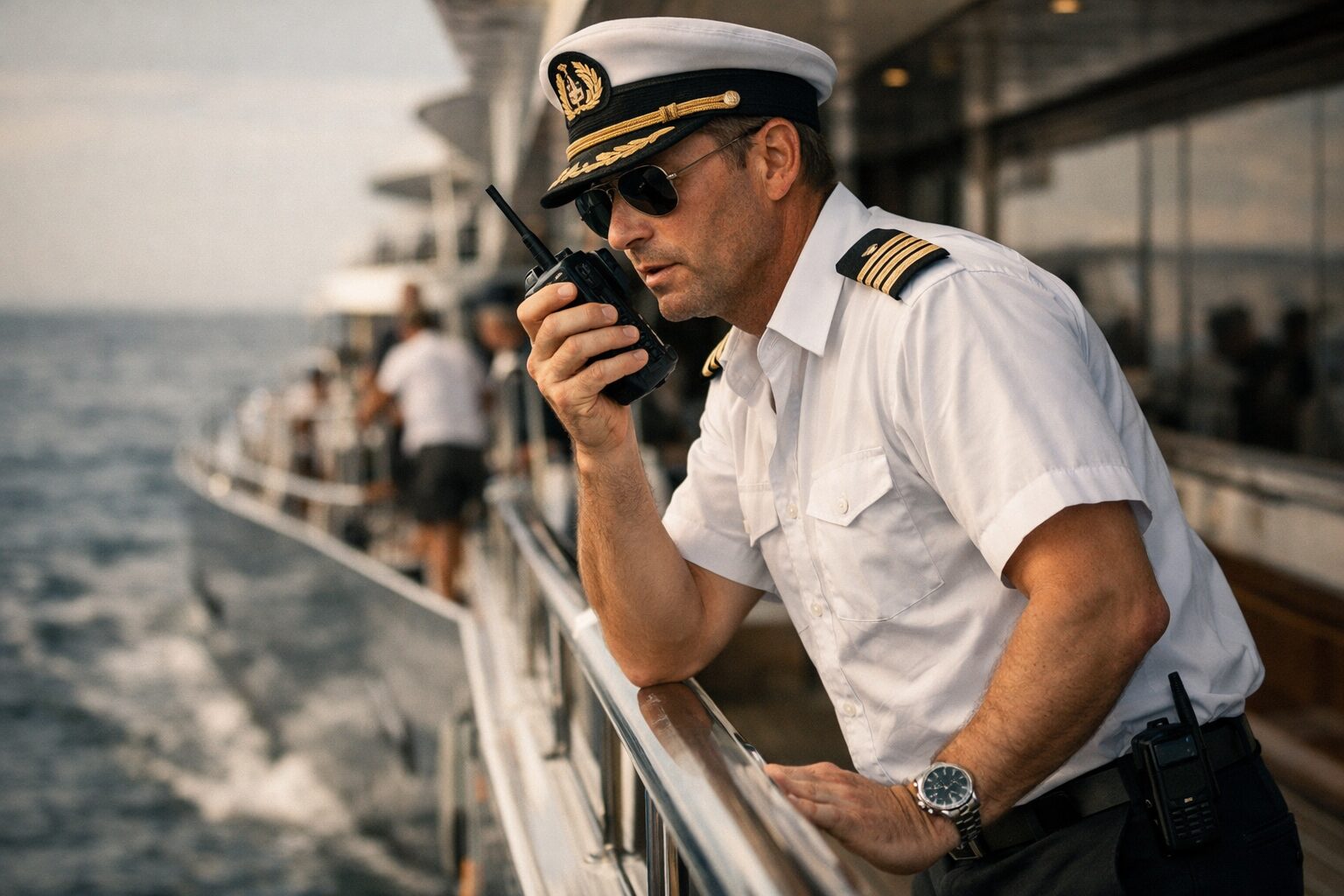
Qualifications. A commercially-endorsed Master (Unlimited) or Master 3000GT certificate, STCW basic and advanced training, GMDSS operator certification, and — for most large yachts — years of progressive experience from deckhand to officer to master. Many captains also hold a Pilotage endorsement for key cruising areas such as the French Riviera, the Balearics or the Caribbean.
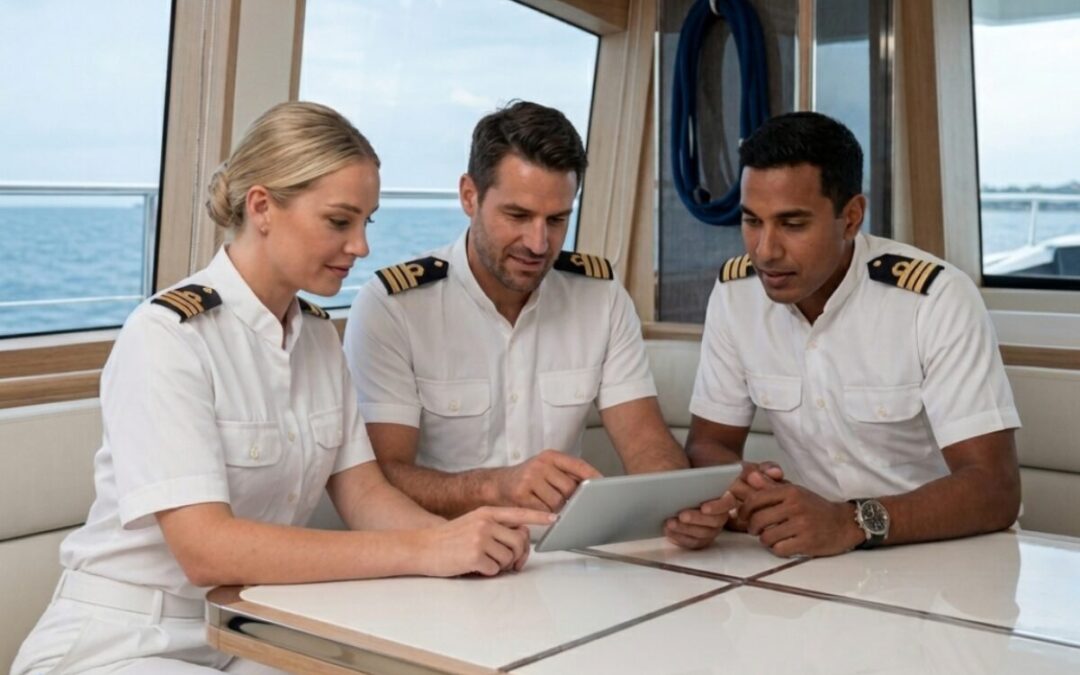
The first officer (mate / chief officer)
The first officer is the captain’s right hand and the senior watch-keeper. On a yacht running 24-hour operations, the bridge is never left unmanned, and the first officer takes command of one of the watch rotations — typically four hours on, eight hours off, day and night.
Beyond watch-keeping, the first officer runs the deck department. They coordinate the bosun, the deckhands and the tenders. They plan and supervise docking and mooring evolutions, which on a 60-metre yacht with a crosswind are non-trivial operations. They manage safety drills, run man-overboard exercises, oversee refuelling, and ensure that every piece of deck machinery is working at the level owners and guests expect.
In many ways, the first officer is the chief operating officer of the deck side. The captain sets direction; the first officer makes it happen on the water and at the quay.
The bosun
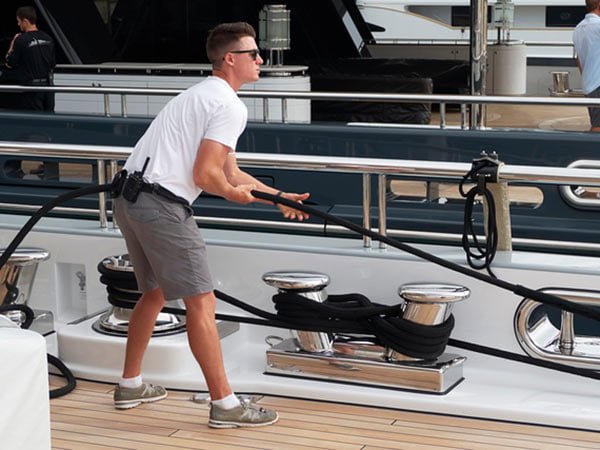
The bosun (short for “boatswain”) leads the deck team. They are the senior deckhand, and the path from bosun to first officer is the most common career route in the industry.
The bosun’s remit is hands-on and visual. They are responsible for the immaculate condition of the exterior — teak decks, stainless steel, paint, varnish, tenders, water toys. They run the toy set-up: the SeaBobs, the jet skis, the e-foils, the diving gear, the paddleboards, the towables. They brief guests on water-sports safety. They drive the chase boat when guests want a private excursion to a beach club.
A good bosun is part engineer, part athlete, part driving instructor, and a master of the small things that make a yacht look the way it looks in the brochure.

The deckhands
The deck team — typically two to six on a 50- to 80-metre yacht — is the muscle and the eye. They polish, they clean, they tie, they splice, they launch, they recover, they drive tenders, they set up toys, they assist at the dock, they hold lines in 30-knot gusts, they wash the salt off everything twice a day.
A junior deckhand on a 50-metre yacht can expect to work 12 to 14 hours a day, six or seven days a week, during charter season. The work is physical, the hours are long, and the standards are unforgiving. It is also, for many, the best training ground in the marine industry.
The interior: the people who look after you
The chief stewardess / head of interior
On a crewed yacht, the chief stewardess (sometimes called the head of interior or purser) is the single most important person in the guest experience. She — the role is statistically held by women in roughly 90% of cases — runs the interior service team, manages the guest schedule, plans events, oversees the laundry, the flowers, the table settings, the wine service, the in-cabin amenities and the often-thankless task of remembering that one guest is allergic to kelp, the other cannot eat gluten, and the third prefers still water at room temperature.
The chief stewardess is also the operational pivot between the guests and the rest of the crew. She attends the daily planning meeting with the captain, then translates the day’s plan into a guest-facing schedule, briefings for the service team, and a thousand micro-touches that separate good service from great service.
In larger yachts she is supported by a purser, who handles the financial and administrative side: charter contracts, advance provisioning allowance (APA) accounting, port fees, guest bills, and the choreography of cash, cards and currencies that comes with moving a floating hotel between half a dozen countries in two weeks.
The stewardesses
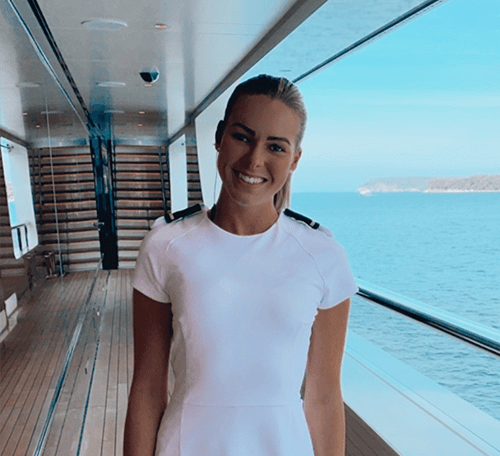
The stewardess team is the largest single department on most superyachts. On a 60-metre yacht carrying 12 guests, four to six stewardesses will be on rotation at any given time.
Their work covers everything the guest sees inside the yacht: the cabins, the salons, the dining areas, the bars, the beach club. They turn down beds. They lay out towels. They set and clear tables, often several times a day. They serve meals, mix drinks, run wine pairings, organise the cocktail hour, manage the music, light the candles, fold the napkins, restock the fridges, freshen the flowers, and — on a 30-metre charter — they do this with a smile and a name.
A great stewardess is a hybrid of a five-star hotel butler, a sommelier in training, a florist, a wardrobe manager and a psychologist. The best ones remember your favourite drink from last year’s charter. The very best ones notice when you have not been sleeping well, and quietly have a different pillow waiting in your cabin without anyone ever asking.
The chief steward / butler
On larger yachts, and on any yacht marketed explicitly as a luxury experience, a butler — sometimes called the chief steward — leads the formal service. His domain is the dining room, the cocktail service, the wine cellar and the formal entertaining.
In an industry where most service is “modern casual luxury,” the butler is the keeper of the old rituals. He decants. He pulls corks. He presents menus. He pours water from the right side, wine from the left. He knows, without asking, when to refill a glass and when to disappear. On a charter with several couples, a competent butler will have the entire table’s preferences memorised by the second sitting.
The role is comparatively rare on Mediterranean charter yachts and more common on US-flag and Caribbean-flag vessels, where formal service is more often requested. On yachts that do carry one, the butler is often the most senior interior hire after the chief stewardess.
The galley: the people who feed you
The head chef
The superyacht head chef is, by some distance, the most pressure-tested role in the industry. They cook three to five meals a day for up to 14 people (12 guests plus the captain), in a galley roughly the size of a small domestic kitchen, with limited storage, constrained refrigeration, no room for a stagiaire, and a guest list whose dietary requirements are usually a five-page document handed over at booking.
The food on a top superyacht is genuinely exceptional — and not by accident. Most head chefs are classically trained in Michelin-rated restaurants, and many have logged time on land before transitioning to sea. They source locally wherever possible: fish off the boat in the morning, vegetables from the market in the port the night before, bread from the village bakery that opened at 5 a.m.

A great head chef does not just cook. They design menus, manage a budget (often five figures a week for provisions on a large yacht), lead a team, handle guest allergies with zero margin for error, and quietly absorb the inevitable last-minute changes — “we have two extra guests tonight, the kids are not eating, and actually one of the adults is now vegan.”
The sous chef and chef de partie
On larger yachts, the head chef is supported by a sous chef and, on the biggest vessels, a chef de partie who runs a specific station. The sous chef is the head chef’s understudy, deputising on days off and increasingly running service under the head chef’s direction. The chef de partie, when present, typically handles one section of the kitchen — sauces, pastry, cold starters, garde manger.
On most yachts under 50 metres, the kitchen is a two-person operation: head chef and sous chef. On a 70-metre-plus gigayacht, the galley team can be four or five strong, especially during charter season.
The engineering department: the people you almost never meet
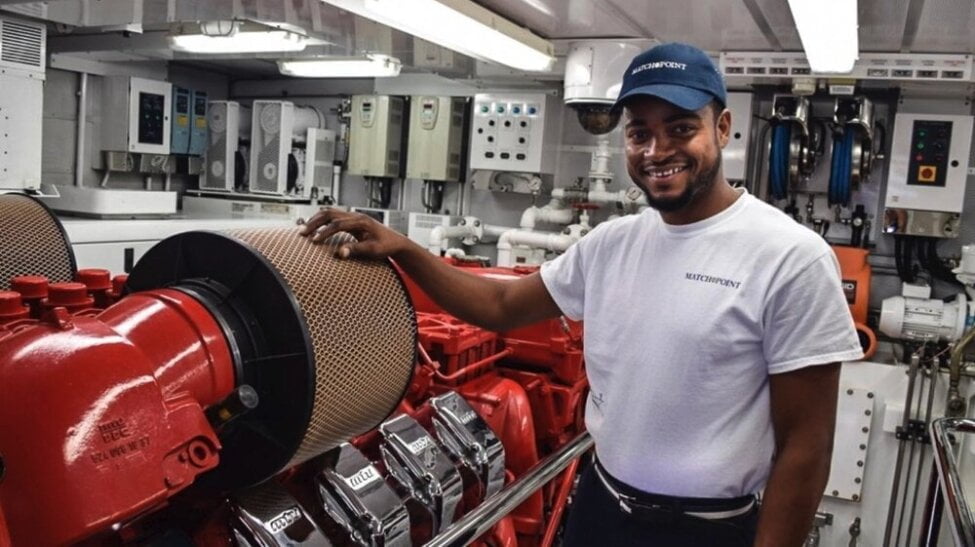
The chief engineer
The chief engineer is the unsung authority on a superyacht. They run the engine room, the generators, the desalination plant, the air-conditioning, the refrigeration, the hydraulics, the waste systems, the fresh-water maker, the stabilisers and, increasingly, the complex AV/IT and bridge electronics that turn a modern superyacht into a floating smart home.
In practical terms, the chief engineer is the reason the lights stay on, the air stays cold, the toilets flush, the stabilisers keep the dinner calm in a four-metre swell, and the shore-power converter does not blow a fuse in Monaco harbour. They are also, like the captain, on call 24/7. If something breaks at 3 a.m., the chief engineer is the one under the floorboards with a torch.
A chief engineer on a 70-metre yacht is, by training, the marine equivalent of a hospital facilities director — but they have to do it in a space the size of a small apartment, with parts that have to be ordered in the next port, in a flag state that may or may not have a chandlery.
The second engineer and the ETO
The second engineer is the chief engineer’s deputy, keeping a watch rotation in the engine room. The ETO — Electro-Technical Officer — is a more recent role, created as yachts have become increasingly electronic. The ETO owns the AV/IT, the comms, the navigation electronics, the satellite link, the onboard networks, the guest Wi-Fi and the security systems. On a 90-metre yacht with a cinema, a beach club sound system, twelve guest iPads, satellite TV and a 5G mesh, the ETO is a full-time specialist role.
Smaller yachts may not carry a dedicated ETO. The chief engineer covers it. Larger yachts treat the ETO as a peer to the second engineer.
How the departments actually work together
The daily routine
On a busy charter day, the rhythm looks roughly like this:
- 06:00. Engineer handover. Night-to-day watch change on the bridge and in the engine room. Deck team starts exterior wash-down.
- 06:30. Chief stewardess and head chef meet. Final review of breakfast, day’s menu, guest preferences and any schedule changes.
- 07:00. Captain, chief engineer, chief stewardess, head chef and bosun meet for the daily planning meeting. Weather, route, port, activities, guest requirements, special requests.
- 07:30. Breakfast service begins. Deck team sets up the toys. Stewardesses lay out the day cabins.
- 09:00 – 18:00. Guest activities. Service, navigation, tender runs, water sports, excursions. Departments rotate staff so that breaks are taken without affecting the guest experience.
- 18:00. Cocktail hour and dinner service. The interior team transforms the deck or the saloon. The deck team secures toys and tenders for the night. The engineer ensures the stabilisers are engaged.
- 22:00 – 02:00. Night service, turn-down, late drinks. Watch-keepers on the bridge. Engineer on call. Some crew sleep; the rest work.
- 02:00 – 06:00. Night watch, deep cleaning, provisioning prep for the next day, rest in rotation.
This is a 24-hour operation, seven days a week, for the duration of a charter. It runs because everyone knows their job and trusts the people next to them.
Charter mode vs. private mode
There is a meaningful operational difference between charter (a paid guest week) and private (the owner’s personal use).
In charter mode, the yacht is a hotel. There is a defined guest manifest, a service standard set by the charter contract, and an external broker (often a MYBA member) acting as the guest’s representative. The interior team operates at peak intensity. The deck team runs excursions at full pace. The engineer keeps the boat in show-home condition. The captain is a host as much as a mariner.
In private mode — when the owner is aboard with family or friends — the rhythm softens. The crew is smaller in service (often by 20–30%), the menu is more personal, and the days are more flexible. Crew still work hard, but the targets shift from “five-star hotel” to “family home.”
Some yachts alternate: a heavy charter season in the Mediterranean in summer, a quieter private period in the Caribbean in winter, or vice versa. The crew rotates in and out, with leaves scheduled around the owner’s calendar.
What crew actually look for in a yacht (and why this matters for you)
The superyacht industry is, in a very real sense, a seller’s market for experienced crew. Good captains, good chiefs, good engineers can pick the boat they work on. That changes what ends up on the best yachts.
When senior crew are choosing between contracts, they weigh a small set of factors:
- The owner. Some owners are respected, supported and well-organised. Some are not. Word travels fast in a 5,000-yacht industry. The best captains will not join a yacht with a reputation for chaos.
- The build standard and maintenance budget. A well-found yacht with a realistic maintenance budget is a fundamentally different workplace from a tired yacht in permanent reactive mode. Senior crew notice the difference in the interview.
- The tip culture and wage structure. Tipping norms are informal but real, and on a charter-heavy yacht the difference between a generous owner and a parsimonious one is a meaningful part of the package.
- The rotation. A 2:2 rotation is now industry-standard for senior crew. A 3:1 or longer is increasingly a red flag.
- The interior. Crews talk. A yacht with a bad atmosphere — cliques, bullying, an unsafe working environment, an absent or abusive leader — does not retain staff. Period.
Why this matters to you as a charter guest: the calibre of the crew is, more than the build year or the LOA, the single best leading indicator of how good your charter will be. A 40-metre yacht with a tight, experienced, happy crew will outperform a 60-metre yacht with a junior, fractious, under-supported team every single time.
When you talk to a charter broker, ask not just which yacht but which crew. Ask how long the captain has been on board, how long the chief stewardess has been there, and whether the team has worked together before. A crew that has sailed together for two or three seasons has a chemistry that no amount of training can replicate. That chemistry is the luxury.
The career path: how you actually become a superyacht crew member
There is no single route, but there are patterns.
Deck. Most officers start as a deckhand. Entry requires STCW basic training, an ENG1 medical certificate, a PWC (jet ski) licence, and usually a powerboat level-2 certificate. From deckhand, the path runs through bosun, mate, chief officer, and finally captain, with sea-time and academic study (often via an OOW or chief mate certificate) along the way. Time to captain from entry: 8 to 15 years.
Interior. Most stewardesses start with hospitality experience, often in a five-star hotel or a private household. STCW is required, plus a food hygiene certificate and a GUEST programme completion in some flag states. Career progression: junior stewardess, stewardess, senior stewardess, chief stewardess. Some transition laterally to the purser role.
Galley. Most chefs come from land-based professional kitchens, often with formal culinary training and several years in restaurants. The transition to sea is increasingly common, with STCW and sea-survival training required. Career progression: sous chef, head chef, executive chef on a gigayacht.
Engineering. Engineers typically hold a marine engineering degree, an HND or a time-served qualification from the merchant marine, the Royal Navy or a commercial shipyard. Many come via the commercial fleet, then transition to yachts for the lifestyle and the pay.
A note on rotation. Most senior crew work a roughly 2:2 rotation — two months on, two months off — or a 1:1 on the largest yachts. Junior crew may work 3:1 or longer. The rotation is the trade for the long hours, the confined quarters and the constant travel. It is also, for many crew, the reason they stay in the industry for decades.
Frequently asked questions
How many crew work on a superyacht? A rough rule is one crew member per 10 metres of length. A 50-metre yacht will run 9 to 12 crew, a 70-metre yacht 16 to 20, and a 90-metre-plus gigayacht 25 to 30 or more.
Who is the most senior person on a superyacht? The captain. The captain has legal authority over the vessel, its guests and its crew, and bears final responsibility for safety, navigation and compliance.
Do superyacht crew sleep? Yes, in rotation. Watch-keepers stand four hours on, eight off. Day crew typically work 12 to 14 hours during charter and have designated rest periods.
How much do superyacht crew get paid? Salaries vary widely by role, yacht size and flag. As a rough order of magnitude in the current market: a junior deckhand or stewardess €2,500–€3,500/month, a bosun or senior stewardess €4,000–€6,000/month, a head chef or chief stewardess €7,000–€10,000/month, a chief engineer or captain €10,000–€20,000+/month, with the largest gigayachts paying more. Most senior crew are also self-employed via a limited company, with full tax structuring their own responsibility.
Do superyacht crew need qualifications? Yes. STCW basic safety training is mandatory worldwide. Deck and engineering roles require additional commercial certificates, and galley roles require food hygiene certification.
Do the same crew stay on the yacht all season? The senior team (captain, chief engineer, chief stewardess, head chef) usually does, on rotation. Junior crew rotate more frequently, often every 6 to 12 months.
Can I meet the crew before booking? On a private or owner-direct charter, yes — most owners will introduce their senior team. On a brokerage charter, the crew is usually presented in the yacht’s profile and via the broker; meeting them in advance is uncommon but not impossible.
Do superyacht crew eat the same food as the guests? No. The chef cooks a separate crew mess menu, usually simpler, faster and designed to fuel a working day. Crew eat in shifts so that guest service is never interrupted.
Final word
When you step aboard a superyacht for the first time, what you are really stepping aboard is the work of 15 to 30 people who have spent the last 48 hours preparing for your arrival. The flowers that look fresh were sourced yesterday afternoon in the last port. The cabin temperature was set the moment the guest manifest was loaded. The water-sports toys that “just happen” to be ready were tested, charged, briefed and laid out before dawn.
The boat is impressive. The toy box is impressive. The marina is impressive. But the experience — the thing you will actually remember from your charter — is the crew.
If you are considering a charter, ask the broker about the team, not the tender garage. The team is the product.


