
The superyacht industry has a sales problem.
It sells boats. The marketing is full of LOAs, top speeds, sundeck jacuzzis, beach clubs, helipads, submarines, helicopter hangars, infinity pools, glass-bottom observation lounges. The brochures are full of glossy renders of empty decks, empty salons, empty sunpads, with not a single human in sight.
And it is wrong. Not about the hardware — the hardware is genuinely extraordinary. Wrong about what you will remember. Wrong about what you will pay for. Wrong about what will define your charter.
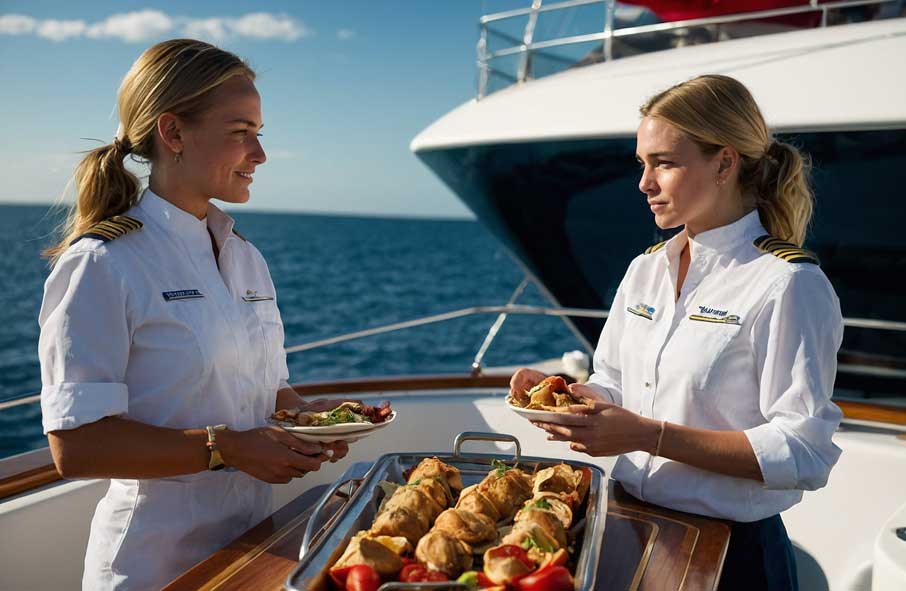
What you will remember is a face. A name. A small act of attention that solved a problem you had not yet articulated. The way your espresso appeared exactly when you wanted it, in the cup you did not know you preferred, on the third morning of a charter you have not yet ended. The way the captain rerouted two hours of cruising to bring you to a cove you had only mentioned in passing over dinner. The way the stewardess noticed, without asking, that you had moved your book to the port shade and quietly rearranged the side table so your drink would catch the breeze.
None of that is in the brochure. All of that is the crew. And that is the real luxury.
The promise vs. the reality of luxury
Let us be honest about what the industry sells.
A 70-metre yacht is, by any normal definition, a spectacular object. It is the size of a small cruise ship. It carries a helicopter. It has a cinema, a spa, a beach club that transforms into a sea-level platform, and enough refrigeration to provision a small village. It cost the owner somewhere between 50 and 100 million euros to build, and another 5 to 10 per cent of that every year to operate.
You would expect a charter on such a boat to be unforgettable. And it can be.
But you would also expect that the experience scales with the boat. That a 90-metre yacht is materially better than a 70-metre, which is materially better than a 50-metre. That bigger is better, the way bigger is better in most consumer purchases. A bigger house. A bigger car. A bigger watch.
It is not. Not at sea, anyway. The reason is simple: in a luxury hotel, the building is the constant and the staff is variable. At sea, on a private yacht charter, the boat is the constant and the crew is the variable — and the variable, in a 5,000-yacht industry, varies enormously.
I have been on 30-metre yachts where the service was so considered, so personal, so quietly competent that guests were still talking about the trip two years later. I have been on 70-metre yachts where the service was a polite, well-meaning, slightly anxious approximation of what it should have been. Same guest profile. Different crew. Completely different experience.
Size is the easy sell. Service is the hard sell. And service is what you are actually buying.

What a great crew actually does that you do not see
The trick of great superyacht service is that, by definition, you do not see it. It happens before you arrive, around you, and after you leave. The best service is, paradoxically, the service you do not notice.
Here is what it actually looks like, in three acts.
Act one: the 5 a.m. wake-up you never witnessed
The day crew on a charter yacht usually starts around 6 a.m. But on the morning of a guest arrival, or the morning after a change of itinerary, the day effectively starts at 5 — sometimes earlier.
The deck team is on the exterior first. They wash down the teak. They polish the stainless. They hose off the sea-salt from overnight. They check every fitting, every flag, every tender, every fender. By the time a guest stirs on the upper deck at 8 a.m., the boat has already been “opened up” — cushions fluffed, towels laid out, glassware polished, the exterior set for the day.
Inside, the stewardesses have already done a full turn. The cabins have been aired. The bathrooms have been reset — fresh towels, fresh amenities, fresh glasses. The flowers from yesterday’s harbour have been replaced. The breakfast layout has been set, the espresso machine warmed, the morning papers — actual printed papers, for guests who still want them — placed in the saloon.
The chef has been up since before the deck team. They have baked the morning bread, prepped the fruit, marinated the proteins for lunch, started the canapés for the cocktail hour that will not happen for fourteen hours. The galley is the first operational space on the boat every day and the last to close.
The captain and the chief engineer have done the morning hand-over, reviewed the weather, plotted the day, sent the customs notification for the next port, and briefed the bosun on the tender schedule. None of this is visible. All of it is essential.
By 8 a.m., the yacht looks like it has been ready for hours. It has been ready for hours. It has been ready for hours because the entire interior and exterior team has been working for two.
Act two: the 200 quiet decisions before your breakfast
Here is a useful mental exercise. Pick any hour of any charter day — say, 7 a.m. to 8 a.m. on a Wednesday in Capri. Count the decisions that have to be made by someone on the boat to make that hour feel effortless.
There are dozens. Is the wind shifting enough to move the breakfast table to leeward? Has the guest’s preferred juice been opened too long and need replacing? Is the deck too wet from the morning wash-down to lay out the cushion covers? Does the guest have a 9 a.m. tender booked, and has the driver been briefed on which route, which music, and whether to bring chilled water? Has the photo drone operator been cleared by the captain for the morning shoot? Is the chef planning a hot breakfast or a cold one, and have the eggs been checked? Does anyone on the boat have an allergy that has not yet been re-confirmed by the chief stewardess?
Two hundred is a conservative estimate. Some of these decisions are explicit. Most are not. Most are absorbed by the heads of department, who then transmit them to their teams through a glance, a muttered word, a head-tilt, a half-sentence. The coordination is almost entirely non-verbal. It is, in a working sense, a form of group performance art.
A great crew has done this enough times that the decisions are reflexive. A struggling crew has to think about each one, and the seams show.
Act three: the service memory
The most important thing a great crew brings is not skill. It is memory.

Service memory is the discipline of remembering, across a single charter, every preference a guest has expressed — the first time, the second time, the implicit way. It is the stewardess who knows, by day three, that you take your coffee with a half-spoon of sugar and a splash of cold milk, that you prefer still water over sparkling, that you like your cabin at 19 degrees, that you read on the port side of the sundeck because the starboard side gets a hard sun in the morning, that you went for a SeaBob yesterday and will probably want one again today, that your partner prefers the bow, that you do not eat shellfish, that your youngest is vegetarian but not vegan, and that you tipped the bosun handsomely on the first tender ride and would probably appreciate a private water-sports session in the afternoon.
None of that is in the brief. All of it is captured by an attentive chief stewardess, transmitted to the relevant department heads, and applied quietly across the rest of the charter.
On a one-week charter, this is impressive. On a two-week charter, it is what separates a good trip from a great one. On a returning charter, where the same crew sees the same guests for the second or third season, it is what makes the experience feel like a second home.
The crew is the memory of the boat. The boat itself does not remember anything.
The quiet problem-solving that defines a charter
The first thing any experienced charter guest will tell you is that something, somewhere, will go slightly wrong on every charter. That is not a criticism of the industry. That is the nature of operating a floating hotel through half a dozen jurisdictions, in a marine environment, with 30 strangers sharing a small space, dependent on weather, fuel, customs, marina availability, provisioning, and the occasional breakdown.
A great crew does not prevent problems. There is no preventing them. A great crew solves them so quickly and so quietly that the guest never registers that there was a problem at all.
Examples, drawn from real charters (with identifying details changed):
- The dive instructor slipped on the swim platform at 7 a.m. and the guest’s preferred 9 a.m. dive looked uncertain. Within 90 minutes, the chief stewardess had rebooked a private dive boat from the local operator, arranged a tender transfer, and the dive went ahead. The guest never knew there had been a question.
- The air-conditioning unit in the master cabin failed at 2 a.m. in mid-August. The chief engineer and the second engineer were on it within minutes. The cabin was cool by 3 a.m. and the guest slept through the entire event.
- A six-guest dinner was upgraded to ten at 4 p.m. when two additional family members joined the yacht mid-afternoon. The chef and the chief stewardess absorbed it, the menu was extended, the wine was pulled from the secondary list, the table was re-set, and the only sign at dinner that anything had changed was that the new guests were offered the same wine as the rest of the table without being asked.
None of these are glamour stories. None of them appear on Instagram. They are routine, daily, and entirely invisible to the guest. They are also the entire reason the charter felt good.

When service becomes art
There is a level above professional service, and it is the one the very best crews reach occasionally and the great ones reach habitually. Call it considered service. Or, if you want to use the industry’s slightly over-loaded word for it, intuitive service.
It is the moment where the stewardess reads the breakfast table and notices, without anyone saying anything, that one guest is on a difficult call and the rest of the table would benefit from a slower service, a softer tone, and the music being turned down a notch. It is the chef who, on the third day, stops preparing a guest’s stated favourite dish and instead prepares what the guest actually wanted but did not know how to ask for. It is the captain who sees the guests getting slightly tired of a busy itinerary and proposes, with no pressure, a slower day at a quiet anchorage — a day the guests will later describe as their favourite of the trip.
These are not scripted acts. They cannot be trained. They emerge from a kind of attentiveness that, in another context, you would call wisdom. They are the moments that turn a luxury product into a luxury memory.
The yacht industry talks about “the experience.” The crew is the experience. The boat is the setting.
The numbers behind the magic
A small sanity-check, in case the picture so far has felt too romantic.
Operating a 50-metre yacht commercially, with a charter crew, costs roughly €4 to €6 million per year. Of that, crew wages, benefits, training, travel, insurance, rotations, uniforms, food and stew-kitties typically represent 30 to 40 per cent. On a 70-metre yacht, crew costs alone can exceed €2 million per year. The largest gigayachts spend considerably more.
Break that down, and what the owner is buying is, per working day, a service operation broadly equivalent to a 30-room boutique hotel — with a guest list of up to 12, a staff-to-guest ratio of 2:1 or better, and a setting that changes every 24 hours.
Wages are only part of the picture. Training is a meaningful line item. A serious yacht budgets €30,000 to €100,000 a year for crew courses, sea-survival refreshers, wine certifications, GUEST programme completion, culinary specialisations, and the constant trickle of regulatory updates. Uniforms, kit, and stew provisions (the small “thank-you” budget the chief stewardess runs for the interior team) cost more than you would expect. So does the annual crew party, the end-of-season gifts, the Christmas bonuses, the travel to and from rotation points.
The point is not the detail. The point is the aggregate. A well-run yacht spends 30 to 40 per cent of its annual budget on its people, and a well-run owner treats that as a feature, not a line item. The owners who treat crew as a cost to be minimised are the same owners whose boats are available at a discount. The market is efficient. You can see the crew quality in the charter fee, if you know what to look for.
The owner is paying — and you, as the charter guest, are partially paying through the weekly rate — for a service operation as sophisticated as a top hotel. Just one that floats, moves, and operates 24 hours a day, in international waters, with no second chance at any meal, no second chance at any interaction, and no second chance at any safety event.
The price tag is high. The expectation is exacting. The margin for error is, in human terms, tiny.
And most of the time, on most yachts, with most crews, it works. Not because boats are easy to run. Because the people who run them are unusually good at what they do.
The crew as a team: how chemistry is actually built
The best crews are not just collections of skilled individuals. They are teams, in the same way a top restaurant brigade is a team, or a Formula 1 pit crew is a team. The skills matter, but the chemistry is the multiplier.
This chemistry is built deliberately. A captain who runs a tight, respectful, well-briefed boat will, over a season, turn a group of strangers into a crew. The mechanism is mundane: a daily planning meeting, a shared language, a thousand small courtesies between departments, a culture where the stewardess who notices the chief engineer has not eaten in six hours quietly puts a plate in the pantry.
The mechanism is also fragile. A new captain who comes in and disrupts the rhythm. A senior hire who does not pull their weight. A charter where one guest is unkind to a stewardess. Any of these can sour a boat in a single season. The same industry that produces extraordinary crews also produces the opposite, and the same deckhand can be brilliant on one boat and miserable on another.
What this means for the guest is straightforward. A yacht with a stable, long-serving crew is, almost by definition, a yacht with a healthy working culture. A yacht where the senior team has been turned over in the last 12 months is, almost by definition, a yacht going through something. Both can deliver a great charter. The first is more likely to.
When service breaks down
It would be dishonest to pretend the industry gets it right every time. It does not. And the same invisibility that makes great service feel effortless makes bad service feel like the boat itself is the problem.
Service usually breaks down for one of three reasons. The crew is too junior. The crew is too small. Or the senior team has lost the plot — sometimes through an internal conflict, sometimes through a tough charter that the captain mishandled, sometimes through a simple misalignment between the owner’s expectations and the boat’s actual operational capacity.
When this happens, the guest experience suffers in tell-tale ways. Breakfast is late. The cabin is not turned down. The tender is not where it should be. The chef is cooking from a tired repertoire. The captain seems distracted. The stewardess is over-promising and under-delivering. The interior smells of cleaning products rather than flowers. The deck is dusty. Nobody is anticipating anything.
None of this is a function of the boat. It is a function of the people. And it is, sadly, more common than the industry would like to admit — particularly on yachts that have been pushed into charter to cover the owner’s running costs, or on yachts that are cycling through a difficult season.
The right response, as a guest, is to give honest, early feedback to the chief stewardess or the captain. Most problems can be fixed mid-charter, and good crew will appreciate the chance to fix them. The wrong response is to absorb the disappointment in silence, leave a poor online review months later, and never book the boat again. The crew wants to know. The broker wants to know. The owner — if they are worth chartering to — wants to know.
Why this matters for you as a charter guest
If you are considering a charter — your first, or your tenth — here is the practical translation of everything above.
The boat you choose matters. Length, layout, age, refit history, toys, tenders, cabins, sundeck, beach club — these are real variables, and they affect your week. The destination matters. The season matters. The broker matters.
But the crew is the multiplier. A good crew on a good boat is excellent. A great crew on a good boat is unforgettable. A great crew on a slightly imperfect boat is still better than a junior crew on the best boat in the marina.
When you talk to a charter broker, talk about the people before you talk about the boat. Ask:
- How long has the captain been with the yacht?
- Has the senior interior team sailed together before?
- Is the head chef a long-term hire or a seasonal contractor?
- What is the stewardess-to-guest ratio on board?
- Has the crew worked a similar itinerary to mine before — same region, same guest profile, same length of charter?
The answers will tell you more about the week you are about to book than the spec sheet ever will.
How to spot a world-class crew before you book
A short, deliberately practical list, because the industry is full of marketing and the truth is usually in the small things.
Look for a long-serving senior team. A captain who has been on board for three seasons, a chief stewardess for two, a head chef for two — that is a yacht that retains its people. Retention is the single best leading indicator of a well-run boat.
Read between the lines of the yacht’s website. Owner-direct and small-fleet websites often feature real photos of the crew, brief bio blurbs, and the names of the senior team. They do this because the crew is a selling point. If the yacht’s website shows only the boat and no crew, the boat is the product.
Ask the broker directly. A good broker will tell you, in plain English, which yachts have the best crews and which are weaker. A broker who only talks about the boat is either inexperienced or is steering you towards an inventory they need to move.
Look for industry recognition. Several yachting awards — the World Superyacht Awards, the ISS Design Awards, the MYBA Yacht Show awards — recognise crew and interior service. A yacht whose chief stewardess has won a service award is a yacht where the interior is taken seriously.
Talk to the chef, even briefly. On a serious charter, the chef will usually be presented in the pre-arrival documents. The quality of the chef’s CV, the cuisines they have worked in, the kitchens they trained in — these are proxies for the quality of every meal you will eat on board.
Frequently asked questions
What is the best part of a superyacht charter? The crew. Almost every repeat charterer will tell you the same thing. The boat is the setting; the crew is the experience.
How can I tell if a superyacht has a good crew? Look at senior team retention, ask the broker directly, review crew bios on the yacht’s website, and ask whether the team has sailed together before. Long-serving senior teams are the best proxy for service quality.
Does yacht size really not matter? It matters, but less than people think. A 40-metre yacht with a tight, experienced crew will out-perform a 70-metre yacht with a junior team every time. Match the boat to your needs, but prioritise the crew over the spec.
How do superyacht crews get trained? STCW basic safety training is mandatory. Beyond that, most crew come from hospitality (interior), professional kitchens (galley), commercial shipping (engineers) or the merchant marine / navy (officers). Many pursue additional certifications, including PWC instructor tickets, GUEST programme completion, sommelier courses and food hygiene certificates.
Are superyacht crew paid well? Compared to land-based hospitality roles of similar seniority, yes — particularly for the senior team. Junior crew earn less, but senior roles on large yachts (captain, chief engineer, head chef, chief stewardess) command five-figure monthly salaries with no housing, food or uniform costs, and a multi-month off-season.
Is tipping the crew expected? On a brokerage charter, the standard industry practice is a gratuity of 5 to 15 per cent of the charter fee, distributed among the crew. The mechanics, the timing, the cash vs. bank transfer question, and the regional variations are all covered in detail in our dedicated tipping guide.
Can I request a specific crew? For a private or repeat charter, often yes — particularly if the owner is keeping the team across seasons. For a brokerage charter, the crew is part of the yacht, not a custom selection.
Final word
The superyacht industry has spent thirty years selling bigger boats. It will probably keep doing that, because bigger boats are photogenic, and a 90-metre hull in a glossy render is a more efficient unit of marketing than a junior stewardess polishing glassware in a working galley.
But if you have chartered — really chartered, more than once, with eyes open — you already know what we are saying. You know the boat is half the story. You know the crew is the rest. And you know that the next time you book, you will not be asking the broker for a bigger sundeck.
You will be asking about the captain.
