
There is a moment, usually on the last night of a charter, when the question of tipping lands. Sometimes the captain raises it delicately, in the context of the disembarkation plan. Sometimes the chief stewardess hints at it. Sometimes the broker sends a one-liner the week before. More often than not, it is the guest who raises it, awkwardly, between the dessert and the digestif, because no one ever told them what the protocol actually is.
This guide is for that guest. It is also for every guest who has Googled “yacht charter tipping” the morning after disembarkation, wondering whether the envelope they handed over was the right amount, in the right currency, to the right person.
Tipping on a superyacht is not a black box. It is a long-standing industry practice, broadly consistent across the Mediterranean, the Caribbean and the US East Coast, governed by a clear default range and a small set of regional and contractual variations. The confusion is not because the practice is opaque. The confusion is because nobody explains it in advance, so guests either under-tip out of ignorance, over-tip out of anxiety, or skip the conversation entirely.
By the end of this article, you will know exactly what to do.

The short answer
If you only have thirty seconds, here it is.
- Industry standard: 5 to 15 per cent of the charter fee, before expenses and VAT. The most common figure, in our experience, sits between 8 and 12 per cent.
- Who receives it: the entire crew, distributed by the captain, usually via a tip pool. The captain does not keep a disproportionate share. The junior stewardess and the chief engineer get a meaningful slice.
- When: on the last night, or on disembarkation morning before the crew leaves the dock.
- How: cash in major convertible currency (euros, US dollars or pounds sterling) is the default. Bank transfer is increasingly accepted. Cheques are not.
- Format: an envelope or a sealed packet handed to the captain, often with a small personal note and individual envelopes for the senior team.
That is the default. The rest of this article is the detail, the regional variations, the edge cases, and the etiquette that separates a generous guest from a thoughtful one.

Why tipping works differently at sea
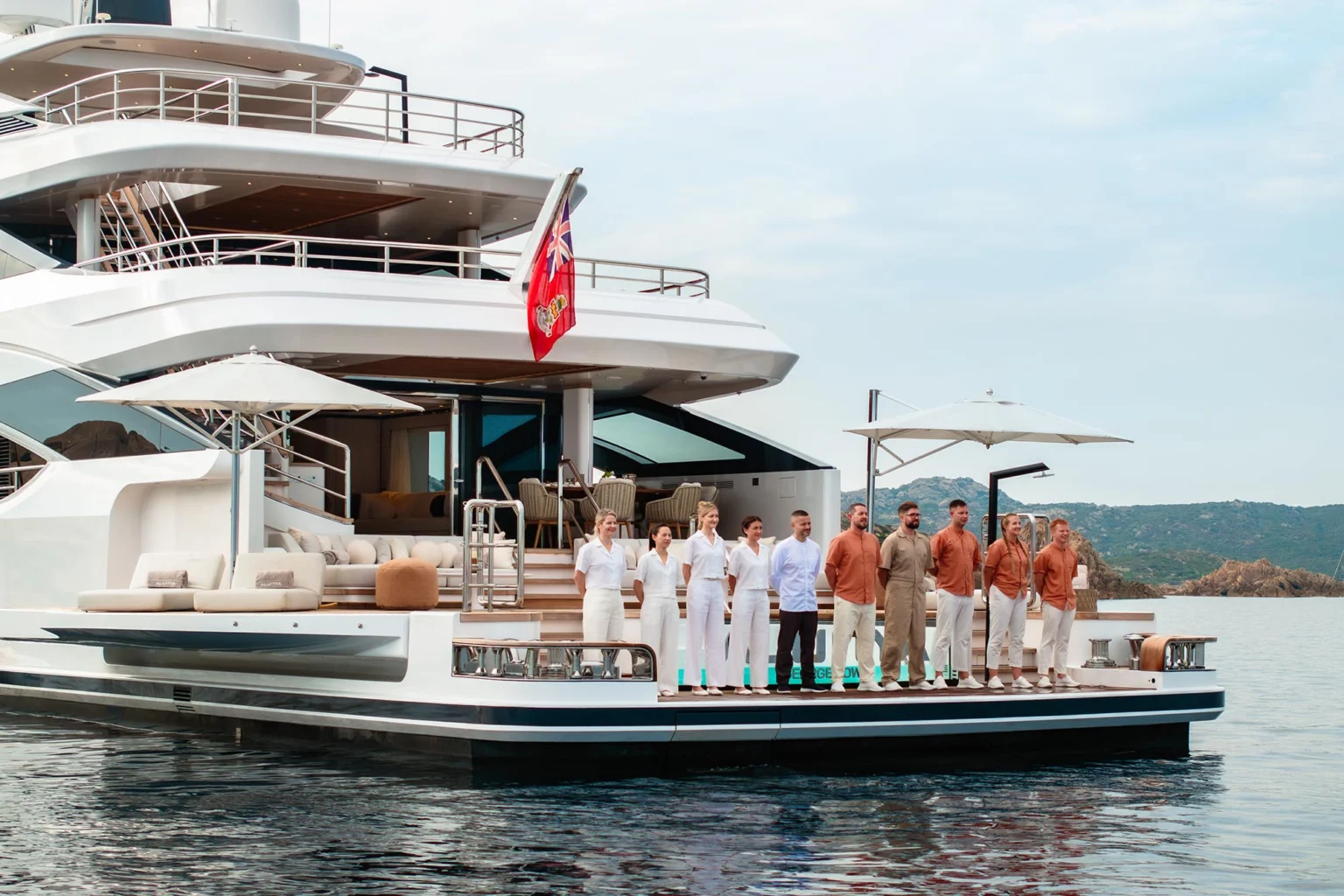
Tipping on a yacht is unusual for a reason. It is not like a restaurant, where the tip goes to one server. It is not like a hotel, where the tip is pooled across an army of largely anonymous staff. On a yacht, the tip is a recognition of a small, identifiable, named team that has worked an extraordinarily intense week in your presence, often at considerable personal cost — long hours, no days off, time away from family, a confined working environment and a level of service that has, in many cases, materially shaped your holiday.
It is also a recognition that the wages on a yacht, while good by hospitality standards, are not commensurate with the workload. Senior crew on a 50-metre yacht will earn €7,000 to €15,000 a month, but the months on board are 12- to 16-hour days, seven days a week, for weeks at a stretch. Junior crew earn significantly less. The tip is, in real terms, part of the compensation. The industry knows this. The crew knows this. The brokers know this. Most first-time guests do not.
A second reason tipping is unusual: in many parts of the world, charter guests and crew live, eat, work, swim, sunbathe and sometimes sleep in the same horizontal space for a week. The crew is in your living room. You are in their workplace. The tip closes that loop — it is a final, formal thank-you, with a clear financial expression, that lets the relationship end cleanly.
For a first-time charterer, this is the most useful mental model: the tip is not a service-industry gratuity in the American sense. It is closer to a year-end bonus, adjusted to a single week, paid directly to the people who earned it.

The industry standard: how much should you tip?
The 5 to 15 per cent rule
The widely accepted industry standard is 5 to 15 per cent of the charter fee, before expenses, before the Advance Provisioning Allowance (APA), and before VAT where applicable.
Most captains and chief stewardesses, asked privately, will say that the most common amount on a well-run charter sits between 8 and 12 per cent. Below 5 per cent is felt as disappointing. Above 15 per cent is exceptional and rare.
The range reflects three variables: the size of the boat, the duration of the charter, and the quality of the experience.
A short, smooth charter on a smaller boat might warrant a tip at the lower end. A long, complex charter with a multi-generational guest list, a demanding itinerary and a high-touch experience will often tip at the upper end. An unforgettable charter — the kind where the crew handled a medical event, a weather reroute, a difficult family dynamic and a last-minute guest change without a single seam showing — will occasionally tip above 15 per cent, and the chief stewardess will remember the gesture for the rest of her career.
A quick worked example, because the math is where most first-timers go blank.
A one-week summer charter in the Mediterranean on a 45-metre yacht, with a charter fee of €350,000:
- At 5 per cent: €17,500
- At 10 per cent: €35,000
- At 15 per cent: €52,500
Of those, €35,000 distributed across, say, 10 crew is €3,500 per crew member, on top of wages, for one week. That is a meaningful sum. It is also, in context, fair.
Bareboat vs. crewed vs. luxury crewed
The 5 to 15 per cent rule applies to crewed charters, including fully crewed luxury yachts, catamarans with skipper and hostess, and motor yachts with captain and mate.
It does not apply to bareboat charters, where you rent the boat without crew and do the sailing yourself. On a bareboat, there is no one to tip, unless you have hired a freelance skipper for the week, in which case a tip of 5 to 10 per cent of the boat’s weekly fee is appropriate, or you have paid a one-off gratuity at the end.
It also does not apply to skippered charters on smaller boats (under 24 metres), where the skipper may be paid a slightly higher base wage in lieu of a tip. The standard here varies by region and by operator, and your charter company will usually clarify in advance.
What follows in this guide is written for the fully crewed luxury charter, where the 5 to 15 per cent rule applies in full.

Who gets the tip? The tip pool system
The tip is not a per-person transaction. The captain and the chief stewardess collect the gratuity, then distribute it across the crew according to a formula that is, broadly, internal to the boat.
The standard split is a point-based system. The captain and the chief engineer get the most points (typically 1.5 to 2 points). The chief stewardess and the head chef are next (1.25 to 1.5 points). Senior officers and senior stewardesses get 1 to 1.25 points. Junior crew, deckhands and stewardesses get a single point. The total tip is divided by the total number of points and multiplied by each crew member’s individual allocation.
This system exists for a reason. It is the only way to distribute a shared gratuity fairly across a team of 10 to 25 people with very different roles, very different wages, and very different contributions to the charter. Without it, every charter would end in awkward negotiations about who deserved what.
What this means in practice for the guest: you do not need to tip the stewardess separately from the bosun. You do not need to slip individual envelopes to the deckhand who gave your child extra water-ski rides. You hand the total to the captain, with whatever gesture of personal recognition you want to add, and trust the internal system to do its work.
A small exception. If a particular crew member did something extraordinary for you — the stewardess who organised a surprise birthday cake, the bosun who spent two hours helping your teenager master the e-foil — a separate, smaller personal envelope to that person, alongside the main tip, is warmly received. Do not, however, hand the main tip directly to a junior crew member and bypass the captain. It creates awkwardness and breaks the internal system.
When and how to give the tip
Cash, bank transfer, or a mix
Cash is still the default. The reason is partly practical (a large cash tip can be split on the spot, in the right currency, without bank fees or conversion losses) and partly cultural (the yachting industry is a long way from being a digital-first business, and large sums of cash remain routine).
The cleanest approach is cash in the local currency of the charter base, or in euros for a Mediterranean charter, US dollars for a Caribbean or US charter, and pounds sterling for a UK charter. Bring a mix of denominations. A €52,500 tip in €500 notes is much harder to distribute than the same amount in €50s and €100s.
Bank transfer is increasingly accepted, particularly on larger yachts and for high-value tips. The captain or the purser will usually provide banking details on request, with a clear indication of the account holder. A bank transfer is also a cleaner option for guests who do not want to carry large sums in cash, or who are tipping in a currency that is hard to source. The downside is timing — the transfer may not clear before the crew rotates off, in which case it follows them later, and the warm, in-person moment is lost.
Cheques are largely a thing of the past. Travellers’ cheques even more so. Cryptocurrency is not yet an industry standard. Do not assume the captain can break a €1,000 note in port; bring a sensible spread.

Timing: last night vs. disembarkation morning
There are two schools of thought.
The last-night approach: hand the tip to the captain at dinner, in a brief, low-key moment — between courses, or as guests and crew are saying goodnight. This is the warmer, more personal option, and most crew prefer it. The gesture lands while the relationship is still alive, in person, with eye contact and a small exchange of thanks.
The disembarkation-morning approach: hand the tip to the captain or the chief stewardess as guests are leaving the yacht, often with a final word and a handshake. This is the more formal option, and it has the advantage of being a clean, transactional moment that does not interrupt the previous evening’s flow.
Both are acceptable. Either works. The thing to avoid is handing the tip over without acknowledgement, in an envelope, with a one-liner and a retreat. The crew is human. A small, sincere moment of recognition lands far better than the largest envelope left silently on the dresser.
The envelope, the handshake, the letter
A few small touches that make the gesture feel considered rather than perfunctory.
- An envelope, or a sealed packet. A white or cream envelope, a clean folded note, or a small branded pouch from the broker. Avoid loose cash handed across the bar.
- A short handwritten note. Not a speech. Three lines — what you particularly appreciated, by name if you can, and a clear thank you. The captain may share it with the crew, may read it at the post-charter debrief, may keep it for years. A small written word carries disproportionate weight in a 24/7 service business.
- A personal word to the senior team. A short, in-person thank you to the captain, the chief stewardess, the head chef and, if you have had meaningful interaction with them, the chief engineer and the bosun. Five minutes at the end of the charter is the right amount of time.
- Individual envelopes (optional). If you have built a particular rapport with one or two crew members and want to give them something extra, a small, separate envelope for that person is welcome. The amount does not need to be large. The recognition does.
Tipping etiquette: what to do (and what not to do)
The do list is short:
- Do tip within the 5 to 15 per cent range.
- Do tip in cash, in the local currency, in sensible denominations.
- Do give it to the captain, with a small personal note.
- Do say something specific in your note or in person. “Thank you” alone is fine. “Thank you for the surprise lunch at that little cove on Wednesday” is better.
- Do ask the broker in advance if you are unsure about the customs of a specific region or flag.
The do-not list is shorter and more important:
- Do not tip a junior crew member directly and bypass the captain. It creates awkwardness and breaks the pool system.
- Do not announce the tip amount in front of other crew. The captain should know; the rest of the crew should learn their share through the internal system, not through overhearing.
- Do not treat the tip as a transaction to be negotiated. The 5 to 15 per cent range is not a haggling range. The captain is not a market vendor.
- Do not withhold the tip because the boat had a minor issue. Equipment fails. Weather changes. A bridge crew is human. The tip is for the service, not the perfection.
- Do not tip in a non-convertible currency, in cryptocurrency, in a cheque, or in any other form that creates a logistical problem for the crew.
Special cases and edge scenarios
Exceptional service above the standard
On most charters, the crew does their job well. On some, the crew exceeds it — a medical event handled calmly, a difficult itinerary rerouted seamlessly, a dietary requirement met with creativity and grace, a child entertained through a long crossing, a last-minute guest list change absorbed without a flicker.
When the service is genuinely outstanding, tipping at the top of the range or slightly above is appropriate. The crew will, in turn, often use the over-tip to fund the post-season crew party, the end-of-season gifts, or a small bonus for the junior members who carried the load.
Service that fell short
It happens. The chef had an off week. The stewardess was learning the boat. The captain was preoccupied. The tender driver was late. The cabin was not turned down on time.
A first response, before adjusting the tip, is to raise the issue with the chief stewardess or the captain during the charter, in a constructive way. Most problems are fixable mid-charter, and most crew will appreciate the feedback. A small tip reduction with no prior conversation feels unfair; the same reduction with a prior, clear conversation feels proportionate.
If the issues were severe, serious, and not addressed during the charter, tipping below the 5 per cent floor is acceptable. Some guests leave nothing at all. That is a strong signal. A short, written explanation to the broker is a useful follow-up, because the broker can pass the feedback to the yacht and to the management company for next season.
Tipping on a long charter (two weeks or more)
A two-week charter is, in crew terms, a long engagement. The tip is typically calculated on the same 5 to 15 per cent basis, but on the full two-week fee, and is paid at the end of the second week. The crew has earned it. The relationship will often be warmer by week two than by week one, and the tip is a fitting close.
Regional variations
The 5 to 15 per cent range is broadly consistent worldwide, with small regional differences.
- Mediterranean (France, Italy, Spain, Greece, Croatia). Cash in euros is the default. 10 per cent is a common, generous, well-regarded figure. The French Riviera and the Italian coast tend to be at the upper end of the range; Greece and Croatia can be slightly more relaxed.
- Caribbean (British Virgin Islands, St. Barts, Antigua). US dollars. The Caribbean charter market has the longest-established tipping culture in the industry, and 10 to 15 per cent is common for excellent service.
- US East Coast (Florida, New England). US dollars. The American gratuity culture is well established, and 15 to 20 per cent is occasionally seen on top-end yachts, though 10 to 15 is more typical.
- South Pacific and Asia. More variable. Cash in US dollars is the safest default. Where chartering is less common, guests sometimes ask the broker in advance for the local custom.
The single most useful thing you can do, in any region, is ask your broker before you sail. They will know. They will appreciate the question. And they will spare you the awkward last-night conversation.
The myth of “it’s included”: VAT, MYBA and the fine print
Some charter contracts, particularly in the Mediterranean, include a line that reads “gratuity at the discretion of the charterer” or “crew gratuity customary.” A smaller number of contracts, particularly on owner-direct yachts, advertise a “fully inclusive” fee that supposedly covers everything.
Neither includes the tip. The MYBA charter agreement — the industry-standard contract for professionally-managed yachts — explicitly excludes crew gratuity from the charter fee. It is a separate, expected, customary payment. The same is true under most regional charter contracts.
What the charter fee does include: the boat, the crew, the insurance, the base provisioning, the toys, the tenders, the navigation equipment, and the basic consumables.
What the APA (Advance Provisioning Allowance) covers: the running costs of the charter — fuel, food, drinks, port fees, marina fees, customs, transfers. Typically 25 to 35 per cent of the charter fee, paid in advance, reconciled at the end.
What VAT covers: the value-added tax, where applicable. In the EU, this is between 13 and 25 per cent depending on flag, flag state, and whether the charter is commercially or privately operated.
The tip sits outside all three. It is the only part of the charter cost that the crew receives directly, and the only part of the transaction that is governed by custom rather than contract.
A sample tipping budget by yacht size
A pragmatic table, because the absolute numbers are often what first-timers want to see. All figures assume a one-week summer Mediterranean charter, a 10 per cent tip, and a typical charter fee for the segment.
| Yacht size | Typical weekly fee (Med) | 5% tip | 10% tip | 15% tip |
|---|---|---|---|---|
| 30 m motor | €120,000 | €6,000 | €12,000 | €18,000 |
| 40 m motor | €220,000 | €11,000 | €22,000 | €33,000 |
| 50 m motor | €350,000 | €17,500 | €35,000 | €52,500 |
| 60 m motor | €500,000 | €25,000 | €50,000 | €75,000 |
| 70 m motor | €700,000 | €35,000 | €70,000 | €105,000 |
| 80 m+ gigayacht | €1,000,000+ | €50,000+ | €100,000+ | €150,000+ |
These are illustrative. Actual fees vary widely by season, region, yacht age, builder, and demand. The 10 per cent column is the one most guests will end up somewhere near.
For a one-week Caribbean or US charter, fees and tipping totals are broadly comparable, with the cash in US dollars and the upper end of the range a little more common.
Frequently asked questions
How much do you tip a superyacht crew? The industry standard is 5 to 15 per cent of the charter fee, before expenses and VAT. Most guests tip between 8 and 12 per cent. The captain and the chief stewardess can answer any specific question in advance.
When do you tip a yacht crew? On the last night of the charter, or on disembarkation morning. Most guests tip on the last night, in person, with a small handwritten note.
Do you tip in cash on a yacht? Yes, cash is the default. Major convertible currencies (euros, US dollars, pounds sterling) in sensible denominations. Bank transfer is increasingly accepted, especially on larger yachts.
Who do you give the tip to? The captain. The captain and the chief stewardess distribute it across the crew via an internal point system. Do not tip junior crew directly and bypass the system.
Is the crew tip included in the charter fee? No. The MYBA charter agreement and most regional charter contracts explicitly exclude gratuity. It is a separate, customary, expected payment.
What if the service was poor? Raise the issue with the captain or the chief stewardess during the charter, so it can be addressed in the moment. If the problems are severe and unresolved, a tip below 5 per cent is acceptable, and a brief note to the broker is helpful.
Is tipping different in the Mediterranean vs. the Caribbean? Broadly the same (5 to 15 per cent), but the cash currency differs (euros vs. US dollars) and the upper end of the range is slightly more common in the Caribbean. Ask your broker.
Should I tip the chef separately? No. The tip pool covers all departments. A small, separate personal envelope for a chef who went above and beyond is welcome but not expected.
What if I am on a tight budget? Tip at the lower end of the range (5 to 8 per cent) rather than skipping the tip entirely. The crew works the same hours regardless of the charter fee.
Can I tip in two currencies? Yes, if the total works out cleanly. It is cleaner to convert in advance and tip in a single currency.
Final word
Tipping on a superyacht is, in the end, a small ritual with a big meaning. It is the moment where the service relationship, which has run for an intense week, finds its formal close. Done well, it leaves the guest with a clear conscience and the crew with a fair reward. Done badly, it leaves both sides with a small, lasting regret.
The 5 to 15 per cent rule is a default, not a law. Adjust it for the size of the boat, the duration of the charter, the quality of the experience, and the standard of the region. Tip in cash, in the local currency, in sensible denominations. Hand it to the captain with a small, sincere, specific word of thanks. Trust the pool system. Do not announce the amount. And if the service was unforgettable, do not be shy about saying so, in cash.
The crew will remember. So will you.
